
News and Policies
Century-old pear orchard brings sweet success to Tai'an village
Updated: Sep 20, 2026
chinadaily.com.cn
Print
Share - WeChat

As autumn arrives, the ancient pear orchard in Liyuan village in Tai'an, Shandong province, is bustling with activity. The golden pear variety known as "Jinzhui pear" is now in season, and trees over a century old are heavy with fruit.
Growers like Lyu Changliang and his wife Wang Cuiying are busy picking the sweet fruit. "After the Autumn Equinox, the pears ripen one after another. Picked on a sunny, cool day, they're crisp, sweet, and full of juice," Lyu said. With over a decade of experience, his orchard yields about 7,500 kilograms annually, earning around 30,000 yuan ($4,480).
The village's pear industry dates back centuries. Thanks to favorable mountain and soil conditions, Jinzhui pears are known for their fine texture, rich juice, and sweet, fiber-free flesh. Some trees are over 500 years old and are registered, numbered, and carefully managed by villagers, with guidance from experts from Shandong Agricultural University and the provincial fruit research institute.
The village produces 200,000 to 250,000 kilograms of pears annually, generating 200,000 to 300,000 yuan for residents. Pears can be stored until the Spring Festival.
To extend the value chain, the village cooperative has developed dried pear tea and pear paste. Dried pear tea, made from fresh fruit dried in sunlight, sells for up to 40 yuan per kilogram — about 10 times the price of fresh pears. Plans are underway to collaborate with outside companies on pear juice and other by-products.
"We will protect the ancient orchard, grow the specialty fruit industry, and help villagers earn more," said Guo Jiaying, Party secretary of Liyuan village.
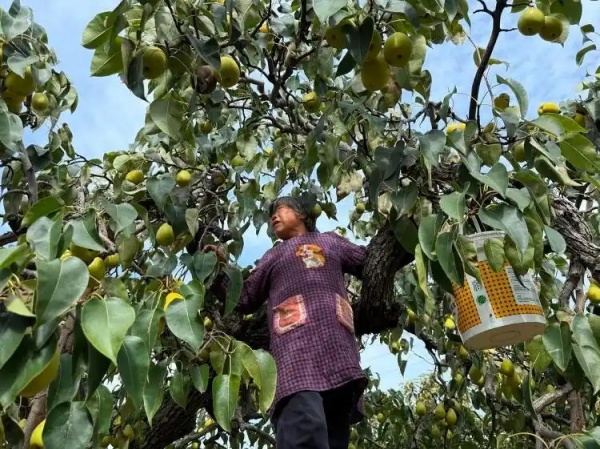
Growers pick Jinzhui pears in a century-old orchard in Liyuan village, Tai'an. [Photo/Dazhong News]