

News and Policies
Millennium-old craft of guqin-making gains new life in Jinan
Updated: Apr 29, 2026
english.jinan.gov.cn
Print
Share - WeChat

In Laiwu district of Jinan, Liu Feng, a fifth-generation inheritor of traditional guqin-making techniques, carefully sands the wooden surface of a guqin– one of the many intricate steps in crafting the ancient seven-stringed instrument.
The Laiwu guqin-making craft was recently recognized as a provincial-level intangible cultural heritage. This craft requires exceptional patience and precision, with each instrument taking more than two years to complete. Rooted in a "10-stage, 200-step" process, the practice encompasses everything from selecting aged timber to final tuning, all done entirely by hand.
A symbol of scholarly refinement for over a thousand years, the guqinfor Liu is more than an instrument – it is a discipline. While preserving tradition, he continues to innovate, developing a five-step method to refine the instrument's structure and optimize its shape and internal cavity to better match the vibration of the strings.
He has also addressed a long-standing challenge in guqinpreservation by reducing cracking caused by drastic humidity differences between northern and southern China. To date, he holds five national patents.
Beyond the workshop, Liu is committed to reviving the instrument for modern audiences. He brings guqinculture into classrooms, curates exhibition spaces, republishes ancient scores, and develops cultural products such as themed bookmarks and incense burners, bringing this centuries-old art form closer to everyday life.
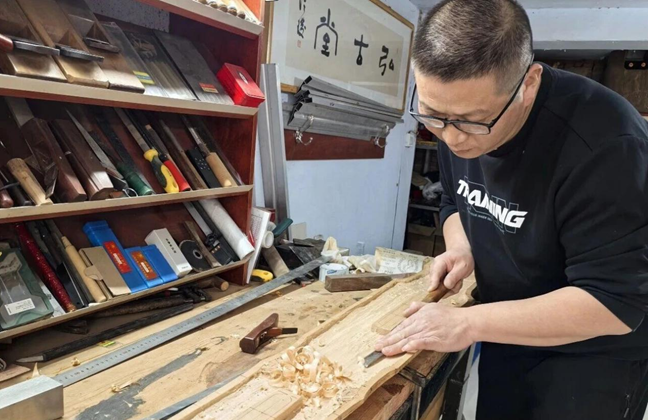
Liu Feng polishes a guqin body, upholding a traditional craft that requires years of patience and precision. [Photo/WeChat account: laiwuxuanchuan]
MOST POPULAR
- 1 Ministry files complaint over EU bill's foreign investment restrictions
- 2 A look at China's economic data in Q1
- 3 China’s 15th Five-Year Plan aligns with UK strengths in services sector
- 4 Double Five shopping festival to boost Shanghai as intl consumption hub
- 5 Chinese cars: From quality to triumph
Editors' Picks


 Infographic:
A look at China's economy in Q1 of 2026
Infographic:
A look at China's economy in Q1 of 2026

