

News and Policies
Once-barren land in Ordos becomes thriving orchard hub
Updated: Jul 22, 2025
chinadaily.com.cn
Print
Share - WeChat

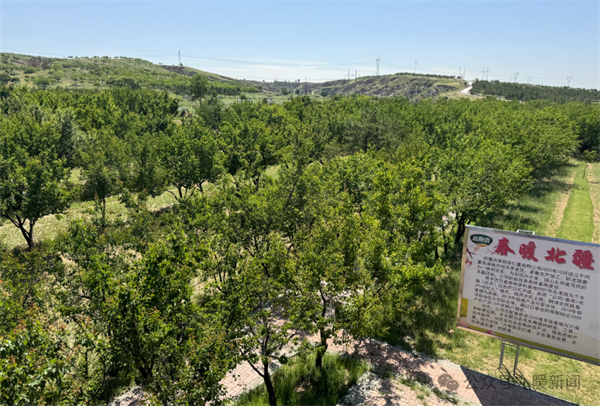
The once-barren land in Juungar Banner is now covered by trees. [Photo/Nuan News]
In Juungar Banner, Ordos, located on the transitional zone between the Loess Plateau and Inner Mongolia Plateau, a remarkable transformation is underway.
Once defined by its rugged, rocky terrain – "seven parts mountains, two parts sand, one part farmland" – the banner now bursts with the vibrant greens of sea buckthorn, wild apricots, and apples.
In 2023, Juungar Banner launched a three-year forestry action plan, aiming to cultivate 1 million mu (66,667 hectares) each of sea buckthorn, wild apricots, mine reclamation, and rocky soil restoration. Today, formerly barren hills are cloaked in green: 920,000 mu of apricot groves and 1.2 million mu of sea buckthorn have boosted vegetation cover to 76.2 percent and forest coverage to 36.38 percent, with soil erosion control reaching 73 percent.
At the heart of this revival is the Inner Mongolia Guojihua Food Technology Co, operating out of the Juungar Economic Development Zone. Its high-capacity production lines churn out 10,000 metric tons of sea buckthorn puree, 30,000 tons of fruit juice, and 30,000 tons of carbonated beverages annually.
These operations process fruits harvested from 1.2 million mu of local sea buckthorn forests – once considered worthless but now dubbed "green bank accounts" by local farmers.
"Last year I earned over 8,000 yuan ($1,115.76) by selling sea buckthorn berries at 5 yuan per kilogram," said Zhang Erzhu, a fruit farmer in Shagedu town. "What we once used for firewood has turned into golden berries."
The international market is also taking notice. "Overseas orders for our sea buckthorn juice are already booked through the third quarter," said company head Yun Tiezhu. "Our berries, rich in vitamin C, are 90 percent sourced from Juungar's wild sea buckthorn – a gift from the Yellow River.”
Meanwhile, in Fulu village, 10,000 mu of apricot groves stretch across the hills. Inner Mongolia Plateau Almond Dew Co has signed 30-year contracts with local farmers, guaranteeing a minimum purchase price of 8 yuan per kg for apricot kernels – with a 15 percent bonus for low-income households.
This enterprise has driven a dramatic shift: its 1 million mu raw material base now benefits 12,000 farming households, increasing their income by an average of 3,000 yuan annually. Since 2007, the company has built a vertically integrated system that includes seedling nurseries, an apricot expo park, and widespread cultivation, empowering farmers through contract farming and technical training.
Yet perhaps the most inspiring tale comes from Deshengyouliang village – home to a true apple-growing miracle.
"In 1990, I planted six apple saplings in the rocky soil – only one survived," recalled 68-year-old Wang Zaida. Today, his 6-mu orchard yields over 45,000 kg of apples annually, generating 720,000 yuan in revenue. His persistence triggered an "apple revolution" in the village, leading to a 2,300-mu orchard that now earns over 30,000 yuan per capita annually.
Tech is also playing its part. At a 120-mu smart orchard managed by China Agricultural University, drones, sensors, and irrigation systems monitor every tree's health. "We helped farmers save 80 percent of a crop from red spider mites using bio-control methods," said graduate student Quan Chunxia.
"Apple farming used to rely on experience – now, it's all about science," said Wang Zaida. "With organic certification, our apples can fetch up to 40 yuan per kg. Soon, 'Nuanshui apples' will be a national brand."
From barren ridges to fruitful orchards, Juungar Banner is proving that even the most unyielding land can bloom – with vision, persistence, and a little help from technology.


