

Museum Updates
Painting a broader universe
Updated: Aug 6, 2026
By Lin Qi
China Daily
Print
Share - WeChat

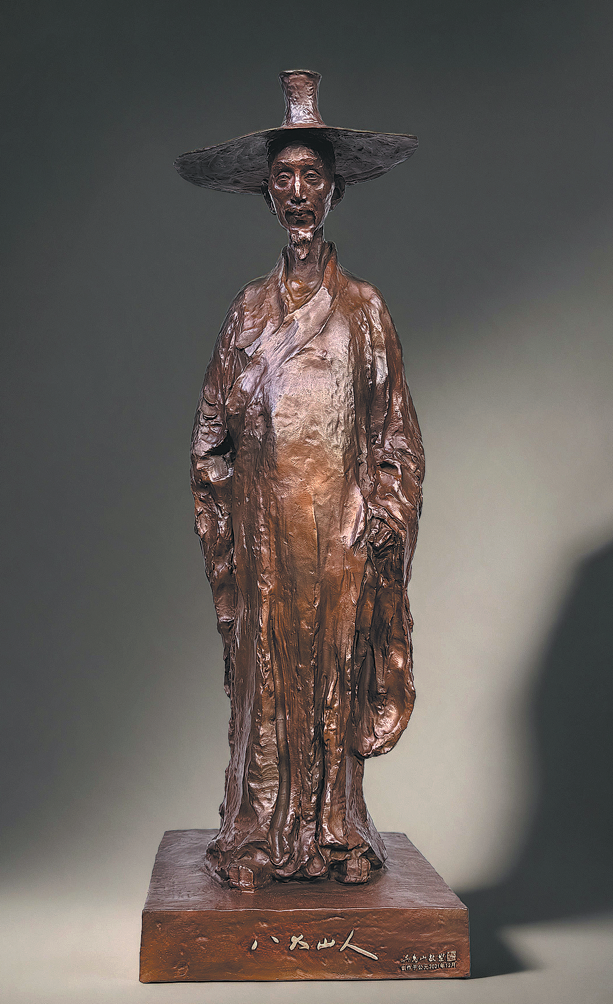
He returned to secular life around 1680. No specific reason was given but he was said to have been seized by sudden madness. Because the political situation had stabilized, he felt a former imperial member like him was no longer a threat to the Qing court.
He returned to Jiangxi only to find his former home had turned into debris, and he was seen as an eccentric man by others. A sense of instability and reclusiveness remained in his heart. He sold paintings for a living and his struggle with the mental illness continued to haunt him while shaping his art.
After 59, he began signing his works "Bada Shanren" — literally, Eight Great Mountain Man — the best-known of his several pseudonyms. No agreed explanation for this unique, yet bizarre pseudonym has been discovered. One popular idea suggests it is a graphic variant and wordplay of the characters for "crying and laughing". The opinion is grounded on his abstract, peculiar brushwork that indicates a mentality of dissonance with mundane affairs.
How he depicted subjects reflects an alternative, extraordinary world perspective. Shapes are exaggerated: rugged stones look like the side of a man's profile, a cat's body is elongated, and the fish has the tail of a bird. They are placed against an empty background, looking as if they are defying gravity. Sometimes a fish is painted above a bird, blurring the boundaries of time and space.
Bamboo by Autumn Window, a NAMOC collection on display, illustrates Bada's artistic philosophy of "less is more" very clearly. Zhao Hui, the exhibition's other curator, says Bada is "a virtuoso of pictorial composition", and in this painting, a contrast is formed between the hard — the square outer window, stiff rock and upright bamboos — and the soft — the circular inner window, three reishi mushrooms and a honeysuckle flower, "which gives a profile of his helplessness and, meanwhile, bemusement with the world".
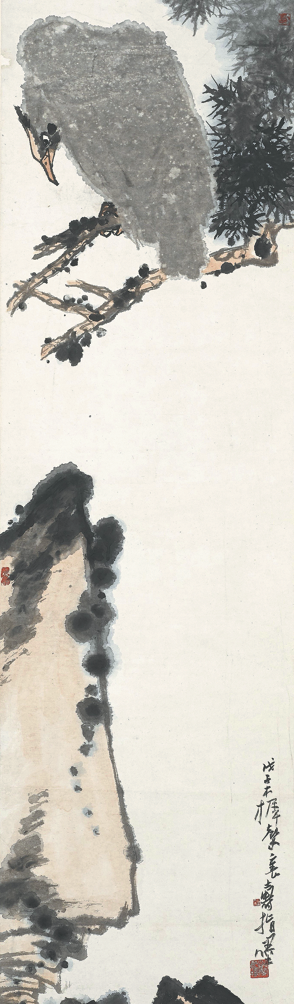
The repertory of images in his works is endowed with rich spiritual symbolism. In loneliness, he sought independence and self-assurance. Rarely did he portray animals in a group, but only one or two: on the mountain road, a deer turns its head and eyes to the sky; two birds stand on tree branches, both on one leg, their upright feathers suggesting a state of alertness. "Whatever he painted was a projection of his inner self," Zhao adds.
Bada achieved artistic maturity in his later years, and his works assumed a more eased state. He revisited the lotus motif — his shabby house was said to be near a lotus pond — and his renderings of lotus blossoms, in a lucid, expansive scenario, evoke an ideal realm of peace and harmony.
"The ethereality in his works, achieved through greatly reduced strokes and emptiness, embodies the idea that all things are equal and life is ceaselessly renewed," says Deng Feng, a senior researcher at the National Art Museum.
In life, Bada's art was rejected by the mainstream, although the artistic spirit and philosophical take of his oeuvre were inherited by influential painters in the 19th and early 20th centuries. The same exhibition shows selective works of these noted personas to reflect Bada's endearing charm in the modern age: the stones in Wu Changshuo's (1844-1927) work; the vast, serene lotus pool under the strokes of Zhang Daqian (1899-1983); and the small animals in which Qi Baishi (1864-1957) commanded innocence.
Bada's influences are everywhere, and his spirit endures through the innovative brushworks of these luminous figures.
One may see similarities between Bada and Vincent van Gogh — tragic in life, a lack of recognition for their unconventional works, and revered after death.
Deng says Bada was, indisputably, the peak in the flower-and-bird genre and the xieyi style of traditional Chinese art. "His simplified brushwork and the spatiality that expands without limit render his work intense spirituality.
"Bada has long been a topic worthy of discussion. Entering his world, we may find ourselves in a broader universe."
Contact the writer at linqi@chinadaily.com.cn
Features
 Festival & Customs
Liangshan Yi Torch Festival lights up Puge with torches and tradition
Festival & Customs
Liangshan Yi Torch Festival lights up Puge with torches and tradition
 Intangible Cultural Heritage
Captivating craftsmanship of dragon and phoenix bronze mirror
Intangible Cultural Heritage
Captivating craftsmanship of dragon and phoenix bronze mirror
