

News and Policies
Cash crops make desert control profitable
Updated: Jun 24, 2026
By FANG AIQING in Yutian, Xinjiang and MAO WEIHUA in Urumqi
China Daily
Print
Share - WeChat

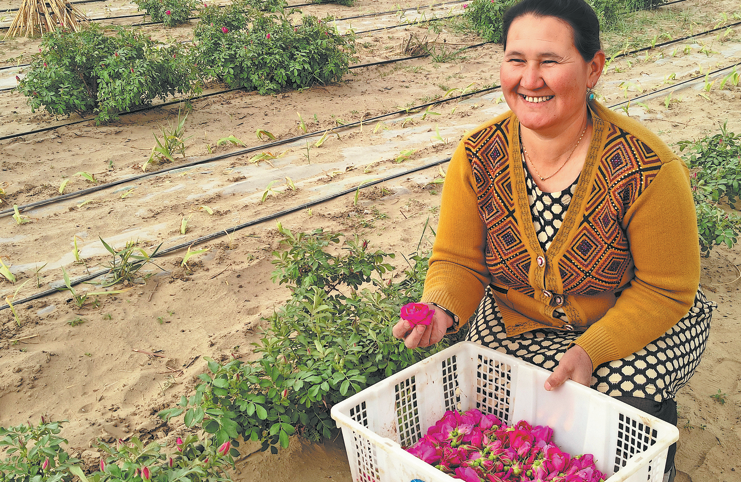
While smallholders benefit directly from the project, larger enterprises are also expanding the model. Xinjiang Silk Road Fruit Treasure Agricultural Development, for example, has contracted 1,133 hectares of sandy land at Wanhuayuan, of which about 813 hectares have been planted with pistachio trees. Around 453 hectares of those orchards are intercropped with roses.
Since 2024, intercropping models that combine trees with shrubs or shrubs with medicinal herbs have been promoted across Yutian, improving sand control while increasing economic returns. It is common to find cistanche growing on the roots of tamarisk and saxaul trees, while some tamarisk plantations are intercropped with Chinese skullcap. Both cistanche and Chinese skullcap are medicinal herbs.
Over the past two months, 148 hectares of tamarisk at Wanhuayuan were interplanted with mugwort. Moxa products derived from mugwort are popular in the traditional Chinese medicine market, while moxibustion continues to enjoy widespread acceptance, indicating strong market potential.
Alim Mamatrozi said mugwort is both drought and cold resistant, making it well-suited to the zone's loose, well-drained sandy soil. Once planted, it can grow steadily for eight to 10 years and be harvested two to three times a year. Its extensive root system helps stabilize sand and soil while contributing to ecological restoration.
He said annual fresh mugwort yields are estimated at 22.5 to 30 tons per hectare, generating revenue of 22,500 to 30,000 yuan per hectare. Part of the investment can be recovered in the first year, with stable profitability expected from the second year onward.
At the center of the 22,000-hectare Tiandong comprehensive desert-control demonstration zone, about 40 km from Wanhuayuan, 2,000 hectares of straw grids have been laid to reduce wind erosion, stabilize sand and protect approximately 333 hectares of desert roses planted in May along both sides of the zone's main road. The roses are intercropped with blackberry lily, Chinese skullcap and liquorice. Tiandong is also part of the sixth phase of the Three-North program.
Xu Guoying, general manager of Xinjiang Tianyuan Agricultural Technology, said the large-scale planting project at Tiandong followed a year of trials conducted on 66.7 hectares at Wanhuayuan. In late 2024, his company invested 3.5 million yuan to contract the trial site and began testing a variety of medicinal herbs in March 2025 to identify species suitable for local cultivation.
The trials showed that sandy land must be thoroughly irrigated and plowed before planting, otherwise yields decline sharply. Machinery played an important role in large-scale planting. Workers rode on tractor-drawn seeders, placing seedlings as the equipment moved across the fields.
During the planting season, about 80 workers were employed on-site each day to plow land, plant crops, apply fertilizer and operate and maintain irrigation systems, earning additional income in the process.
For tall sand dunes, an innovative local approach has been adopted. The dunes have been reshaped into terraces with slopes of about 30 degrees and heights of three to five meters, reinforced with straw grids. The method reduces costs, shortens land preparation time and doubles sand-control efficiency.
Water tanks installed on top of the dunes allow gravity-fed irrigation, reducing electricity consumption and improving water-use efficiency while helping ensure plant survival.
Xu estimates that it will take three years to recover the investment. He said that when the trials began, about a dozen local enterprises and cooperatives were already cultivating medicinal herbs, but similar operations have since expanded rapidly.
To remain competitive, his company introduced 16 additional medicinal herb varieties that are uncommon in the area to Wanhuayuan this year for further trials, while also exploring primary processing to increase added value. He said the new varieties are performing well and showing promising prospects.
Contact the writers at fangaiqing@chinadaily.com.cn
MOST POPULAR
- 1 A look at China's economy in May, 2026
- 2 Yunnan's tax refund wins over international travelers
- 3 166 foreign-invested enterprises approved for value-added telecom services
- 4 China's world natural heritage sites see sustained conservation improvement
- 5 China to further boost railway-tourism integration
Editors' Picks



 Infographic:
China-US cooperation: Mutual benefits, broad reach
Infographic:
China-US cooperation: Mutual benefits, broad reach
 Infographic:
China-US economic ties: The path ahead
Infographic:
China-US economic ties: The path ahead
