

News and Policies
Cash crops make desert control profitable
Updated: Jun 24, 2026
By FANG AIQING in Yutian, Xinjiang and MAO WEIHUA in Urumqi
China Daily
Print
Share - WeChat

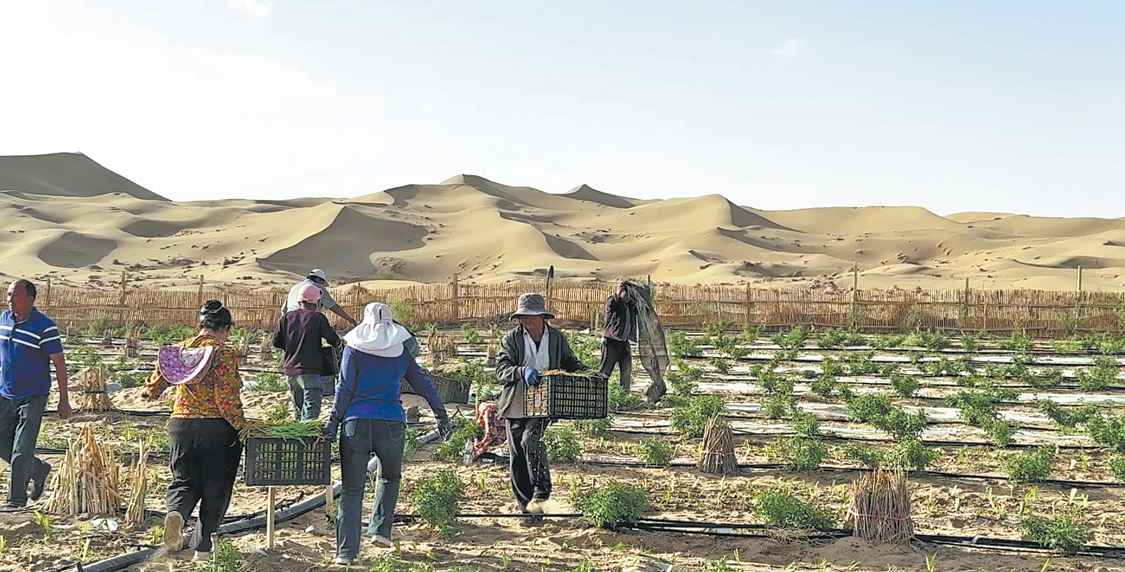
The world's longest desert-encircling ecological barrier has entered a major harvest and production phase, signaling a successful transition from pure sand control to a high-value agricultural economy along the rim of the Taklimakan Desert.
Following the historic completion of the 3,046-kilometer sand-blocking green belt in November 2024, Northwest China's Xinjiang Uygur autonomous region has intensified efforts to transform once-barren dunes into productive farmland. According to the regional forestry and grassland administration, the region has now cultivated approximately 722,000 hectares of desert cash crops, generating a total output value of 29 billion yuan ($4.26 billion) and creating 300,000 stable, long-term jobs for local residents.
A key example of this ecological turnaround is the 2,767-hectare Wanhuayuan sand-control demonstration zone in Yutian county, the site where the final stretches of the trans-desert loop were closed. Today, rows of purple-pink drought-resistant roses and traditional Chinese medicinal herbs serve as a living shield separating the desert from vulnerable interior farmlands.
The Wanhuayuan zone is part of the ongoing sixth phase of the Three-North Shelterbelt Forest Program, a major ecological afforestation project spanning northwestern, northern and northeastern China.
Launched in 1978, the program has increased forest coverage in these regions from 5.05 percent in 1977 to 13.84 percent by the end of its fifth phase in 2020, while bringing 61 percent of soil erosion areas under control.
According to the Xinjiang regional forestry and grassland administration, Xinjiang has planted vegetation over 4.04 million hectares under the program since 2021. Compared with 2022, the region's desertified land area has decreased by 5,300 square kilometers and its sandified land area has shrunk by 1,500 sq km. Natural oases have expanded by 600 sq km, while artificial oases have grown by 44,900 sq km.
Wei Zicheng, Party secretary of Aoyituogelake township, where the Wanhuayuan zone is located, said rose bushes have been planted across 206 hectares on both sides of an asphalt road and contracted to 172 farming households.
In just one and a half years, the bushes have grown to about 70 centimeters tall, with luxuriant leaves and vibrant blossoms. These drought-resistant rose varieties have extensive root systems that help stabilize sand and retain soil moisture. Local residents say sandstorms have become noticeably milder.
Wei said that while the roses bloomed only sporadically last year, they are flowering in large patches this year and beginning to generate returns. Rose buds can be processed into flower tea and essential oils, petals can be made into rose jam, and pruned branches and leaves can be crushed and returned to the soil as organic fertilizer.
Yutian's dry climate, long sunshine hours and large day-night temperature differences are well suited to rose cultivation. According to Alim Mamatrozi, director of the county's forestry and grassland administration, Yutian had planted more than 5,333 hectares of roses by 2025, producing 11,400 metric tons of fresh flowers with an output value of 236 million yuan and benefiting 5,441 households through increased income.
The county has a long history of cultivating roses in desert areas, turning the crop into a pillar industry supported by a complete value chain from field to factory. Deep-processing enterprises have further expanded the industry's value. Last year, locally produced rose essential oils entered the high-end French market.
At Wanhuayuan, within a 100-meter-wide green buffer zone — extending 50 meters on each side of the asphalt road — roses are planted three meters between rows and one meter between plants. Alijan Obul, chairman of the township people's congress, said the survival rate of the roses exceeds 90 percent.
Recently, residents replanted roses in areas where some of the original plants failed to survive. Newly planted seedlings are protected by small reed barriers that shield them from the hot, dry winds that prevail from June to August. Once the plants have been established for about a year and their stems have become woody, they can survive independently.
Four rows of blackberry lilies are interplanted between every two rows of roses. The perennial herb, harvested for its underground rhizomes, is valued in traditional Chinese medicine for clearing heat, detoxifying the body and relieving sore throats.
Yasen Baudun's family is among the 172 households contracted to grow roses and blackberry lilies.
They manage 1.3 hectares and expect their income to double once the crops reach peak production. Previously, they cultivated 0.67 hectares of intercropped walnuts and wheat, earning about 30,000 yuan annually.
While Yasen Baudun handles most of the fieldwork, his wife sells fruit and cares for their children. "If there is more land available, I would like to take on more," he said. "At 36, I'm still young. Two hectares is not too much — I can do more."
He said the local government provides basic infrastructure, including water, electricity and paved roads, as well as subsidies for planting and maintaining roses and medicinal herbs. Farmers prepare the land, install drip irrigation systems, plant seedlings and manage the plots themselves. Saplings are supplied free of charge by the government, while farmers retain all profits.
Machinery offers limited assistance for daily operations, but villagers regularly exchange knowledge and cultivation techniques.
MOST POPULAR
- 1 A look at China's economy in May, 2026
- 2 Yunnan's tax refund wins over international travelers
- 3 166 foreign-invested enterprises approved for value-added telecom services
- 4 China's world natural heritage sites see sustained conservation improvement
- 5 China to further boost railway-tourism integration
Editors' Picks



 Infographic:
China-US cooperation: Mutual benefits, broad reach
Infographic:
China-US cooperation: Mutual benefits, broad reach
 Infographic:
China-US economic ties: The path ahead
Infographic:
China-US economic ties: The path ahead
