
News and Policies
LONGi: China's new energy sector shifts from scale to value
Updated: Sep 18, 2026
www.chinaservicesinfo.com
Print
Share - WeChat

China's new energy industry has entered a critical stage of structural adjustment, a shift in growth drivers and quality upgrading, Zhong Baoshen, president of CNECC.
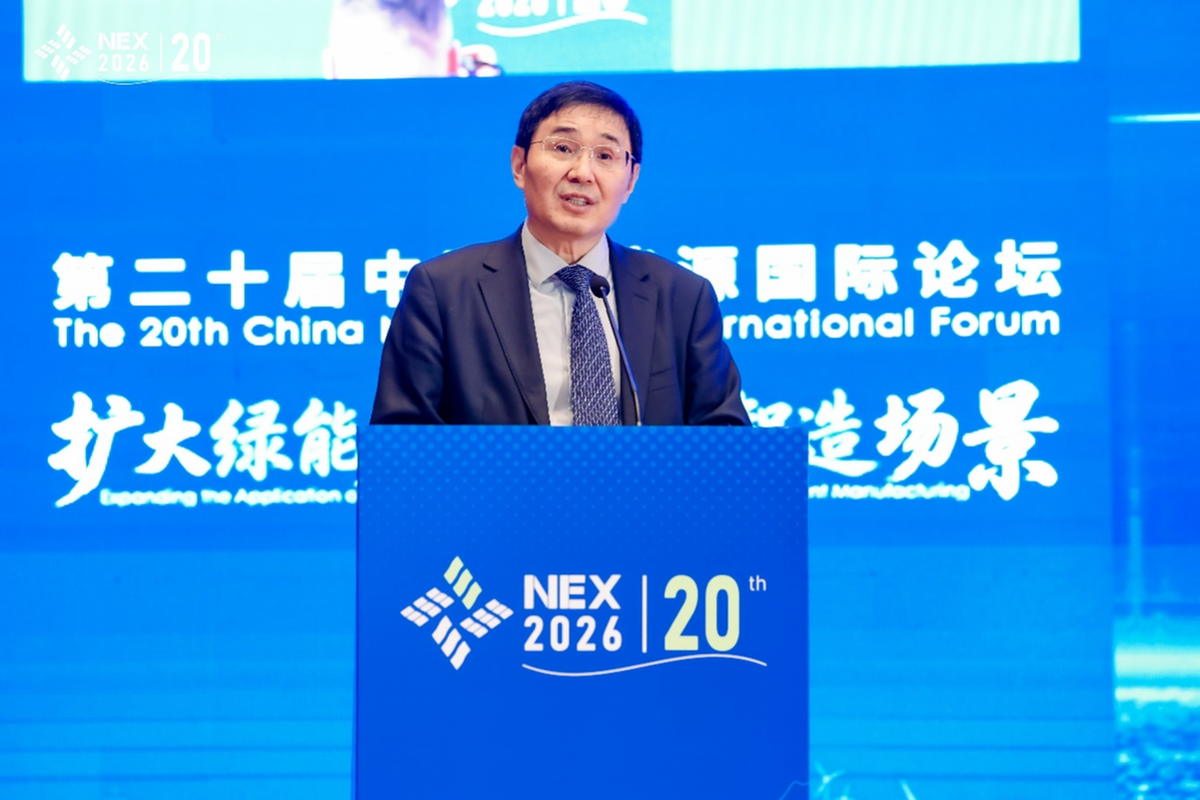
Zhong Baoshen, president of the China New Energy Chamber of Commerce (CNECC) and chairman and general manager of LONGi Green Energy Technology Co Ltd, delivered a keynote speech at the opening of the 20th China New Energy International Forum in Beijing on Sept 17.
It marks the 20th anniversary of the chamber.
Looking back over the past two decades, Zhong said the sector has grown from following global trends to keeping pace with them and then leading them, reversing the old pattern in which equipment, raw materials and markets all lay overseas.
China now has the world's largest new energy industrial cluster, with the most complete industrial chain and support system, he said.
Scale, however, no longer guarantees easy growth. The industry is now in its largest, most complex yet most promising phase, where simple expansion is no longer enough, and high-quality upgrading has become the new imperative.
Zhong said the sector's long-term fundamentals remain rock-solid, as the global energy transition accelerates and the digital economy and artificial intelligence generate massive demand for green power. "Short-term adjustments are an inevitable part of industrial upgrading, and have created fresh opportunities for improving efficiency and pursuing higher-quality growth," he said.
"New energy is moving from a supplementary power source to a main one, and from the generation side to the user side," he added.
Under the "15th Five-Year Plan" for building a new energy system released in June, China will lift the non-fossil energy consumption ratio to 25 percent by 2030. Wind and solar power will account for more than half of the country’s total installed power capacity, officially becoming the country’s mainstay.
To fully unlock green energy's potential, Zhong proposed three key "expansions".
First, expanding coverage, so that new energy spreads from isolated projects to full coverage. Alongside large-scale centralized bases, distributed projects should reach industrial parks, urban buildings, and rural homes.
Second, expanding functions beyond electricity. By coordinating power with heat, hydrogen, and gas, new energy can take root in hard-to-abate fields such as industrial decarbonization, clean heating, and green fuel production.
Third, expanding the mechanisms through which its value is realized. Faster improvement of green power and green certificate trading will turn new energy's environmental and social value into economic returns and encourage more market players to develop and use it.
"An industry can do without scale, but never without technology; it can go through a downturn, but never lose the drive to innovate," Zhong said.
He said the logic of innovation has reversed, with real scenarios rather than technology driving upgrades. AI is reshaping the entire new energy chain as smart production lines are redefining precision and efficiency, while unmanned stations and self-diagnosing equipment are cutting operating costs.
For the photovoltaic sector, innovation always follows real demand.
On the manufacturing side, the industry is moving from "producing first and selling later" to "producing for specific scenarios", offering tailored solutions for different rooftops, terrains, and power loads.
On the business side, real-world demand, such as green hydrogen production, zero-carbon parks, the two-way empowerment between AI and energy, and marine ranching, is driving new business models, moving the sector from manufacturing at scale to value across all scenarios and from manufacturing to smart manufacturing.