

News and Policies
Gravity-1 rocket launches 9 satellites from East China Sea
Updated: Jul 22, 2026
chinadaily.com.cn
Print
Share - WeChat

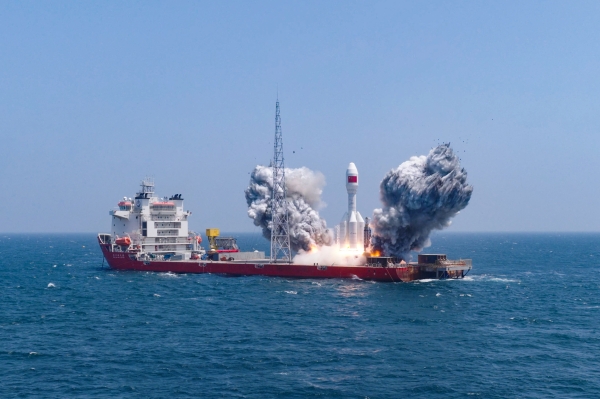
A Gravity-1 carrier rocket lifts off from a launch vessel in the East China Sea on the morning of July 22. [Photo provided to chinadaily.com.cn]
The Gravity-1 Y4 carrier rocket, assembled at the Haiyang Oriental Spaceport in Yantai, East China's Shandong province, was successfully launched from a vessel in the East China Sea on July 22, deploying nine satellites into preset orbit and completing one auxiliary payload experiment.
Developed by Orienspace, Gravity-1 is a medium-lift rocket with a capacity of 6.5 metric tons to low Earth orbit and 4.2 tons to a 500-km Sun-synchronous orbit, supporting up to 30 satellites per mission. At its maiden flight in January 2024, it set multiple records as the world's largest solid-fuel carrier rocket and China's most powerful commercial launch vehicle.
This mission marked its first open-sea launch and the first commercial rocket launch by a private Chinese company in the East China Sea's Yangtze River Delta waters. It further confirmed the rocket's adaptability to complex sea conditions and long-duration standby capability, meaning it is ready for large-scale, commercial operation.
To date, the Haiyang Oriental Spaceport, China's only commercial offshore space launch home port, has supported 26 offshore launches, delivering 164 satellites into orbit with a 100 percent success rate. Over 30 aerospace projects with total investment exceeding 33 billion yuan ($4.56 billion) have been established, creating a full-industry chain ecosystem.
Three national standards for offshore launching, led by the spaceport, have recently been approved and will take effect in November — signaling Haiyang's transition from mission executor to industry rule-maker.
Looking ahead, Haiyang is accelerating its vision of becoming a world-class commercial spaceport, driving forward a modern aerospace industrial system featuring satellites in space, rockets on land, launch vessels at sea and network coverage in the air.