
News and Policies
From runway to city street
Updated: Jul 8, 2026
By YANG FEIYUE
China Daily
Print
Share - WeChat

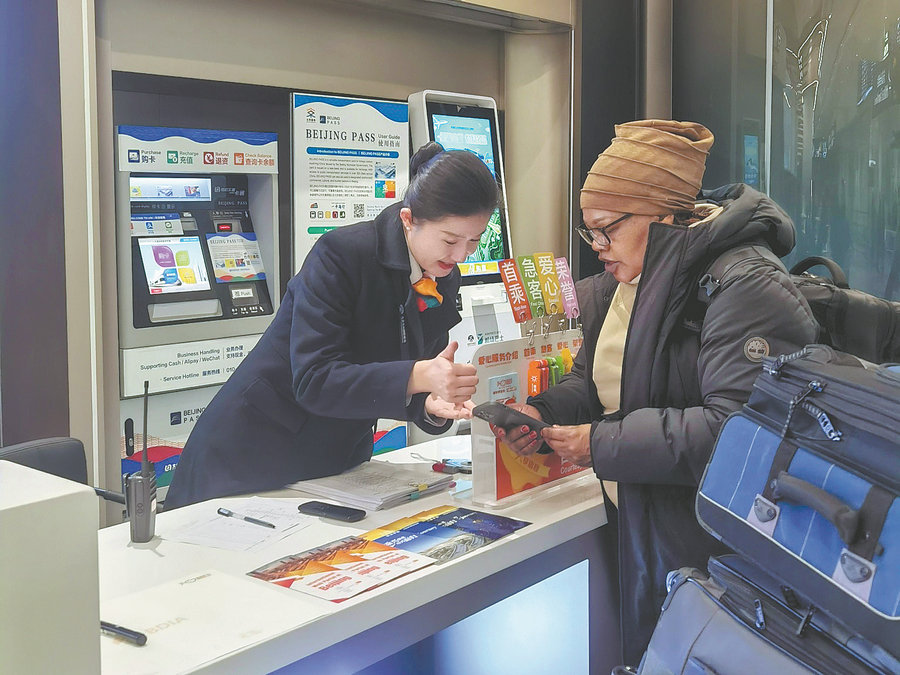
For travelers with time to spare, Beijing Capital International Airport in the northeast of the city now offers complimentary half-day city tours for certain transit passengers.
Wang also points to efforts aimed at showcasing culture rather than simply facilitating movement. Daxing's international departure area features the China Garden, inspired by classical Suzhou landscaping, alongside rotating exhibitions from the National Museum of China and an annual airport carnival celebrating its anniversary.
"The question is no longer how to move passengers efficiently through a terminal," Wang says. "It's how to help them begin exploring the destination before they even leave the airport."
Airlines are undergoing a similar rethink.
Liu Li, chief representative for public affairs and aviation cooperation in China for Finland's flag carrier Finnair, says the airline has increasingly focused on turning the flight itself into part of the travel experience.
Recently, Finnair commissioned Finnish musician Lauri Porra to compose an album titled Matkantekija: Music for Travellers, performed on the traditional Finnish string instrument known as the kantele. The music accompanies passengers through different stages of the journey, from the business-class lounge and boarding process to in-flight service and landing.
The airline's long-haul business-class cabins also feature textiles from Finnish design house Marimekko, including classic patterns inspired by the country's landscapes.
"The one thing we have been working on is making the flight itself the first experience of Finland," Liu says. "That allows us to weave culture and tourism into every part of the journey."
The approach reflects a broader shift taking place across the aviation industry.
Rather than treating a flight as dead time between destinations, airlines are increasingly trying to make it part of the destination itself. For Finnair, that means introducing Finnish design, music and aesthetics long before passengers arrive in the country's capital Helsinki.
If Finnair demonstrates how airlines can turn a flight into a cultural introduction, destinations such as Edinburgh offer a lesson in what happens after passengers land.
Robert Lang, chair of Edinburgh Tourism Action Group's China Ready Initiative, compares aviation and tourism to a 400-meter relay race.
"You might have the best individual runners," he says. "But if you drop the baton in the exchange, you lose."
The baton, he explains, is data, coordination and consistency.
In Edinburgh, airport data are shared with tourism authorities, while changing market trends can trigger rapid adjustments in marketing and visitor services. Success depends less on the strength of any individual organization than on how effectively they work together.
The same logic applies at a larger scale.
Romulo Vallejo, director of statistics and research at the Dominican Republic's Ministry of Housing and Urban Development, argues that airports and destinations should be developed together rather than sequentially.
He pointed to Punta Cana as an example.
When Punta Cana International Airport opened in the mid-1980s, it handled fewer than 4,000 passengers during its first year. In 2025 alone, the airport served more than 11 million passengers and accounted for over half of all air traffic in the Dominican Republic.
The airport and destination grew side by side.
"Build the runway and the destination together and both will thrive," Vallejo says.
Behind the industry's enthusiasm lies a larger economic calculation.
Research from China's Ministry of Commerce shows that inbound tourism revenue currently accounts for less than 0.5 percent of China's GDP. In Thailand, the figure exceeds 10 percent, while in many European countries it ranges between 1 and 3 percent.
The gap represents significant room for growth.
For You Xugong, general manager of Beijing Best Tour Ltd, the challenge is coordination.
Airlines plan routes. Tourism companies design experiences. Hotels provide accommodation. Travelers, however, experience them as a single journey.
"The question is how to make those different parts work together," he says.
Industry associations, he suggests, could help aggregate demand and create stronger incentives for airlines to tailor services and routes.
"If an association can tell an airline that we can bring 100,000 passengers, the airline will listen," he says.
According to the Beijing Municipal Bureau of Culture and Tourism, Beijing received 2.67 million inbound visitor trips from January to May, up 35.3 percent year-on-year. Tourism spending reached $3.64 billion, an increase of 42.4 percent.
Yet integration remains easier to discuss than to achieve.
Liu Huiyuan, chief operating officer of TUI China, which specializes in leisure tourism, says that airlines and tourism companies often operate on different business cycles and incentives.
Most cooperation is still project-based, and there is not yet a long-term mechanism that aligns both sides, he says.
He also points to a structural challenge: airlines operate on fixed schedules and long planning cycles, while tourism demand can shift rapidly in response to holidays, policy changes and market trends.
What is emerging, however, is a broader redefinition of travel.
For decades, aviation and tourism were treated as separate industries. One moved people. The other entertained them after they arrived. Increasingly, destinations are trying to erase that distinction.
Back at Daxing airport, Wang still thinks about first impressions.
The goal, he says, is no longer simply to move passengers from one place to another. It is to make them curious enough to keep exploring.
The plane ticket, in other words, will no longer be just transportation.
It will be the first chapter of the journey.