
News and Policies
Young people hailed as key to advancing common modernization
Updated: Jun 17, 2026
By Ji Haisheng in Wuhan
chinadaily.com.cn
Print
Share - WeChat

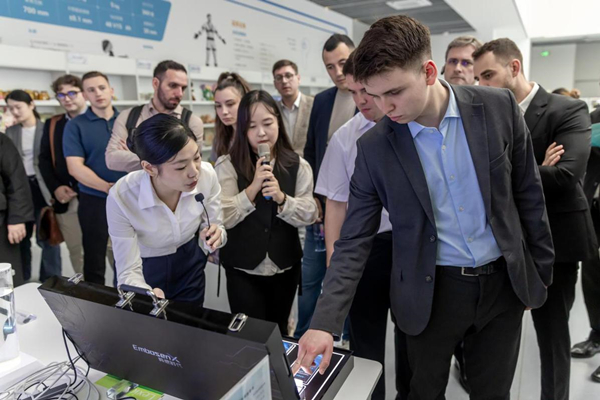
Young political leaders from Central and Eastern European countries visit the Hubei Humanoid Robot Innovation Center in Wuhan, capital of Hubei province, on Sunday, on the sidelines of the 2026 China-CEEC Young Political Leaders Forum. [Photo by Tu Hanming/For chinadaily.com.cn]
Participants at the 2026 China-CEEC Young Political Leaders Forum emphasized that, despite nations following unique paths to modernization, young people have become pivotal forces in driving common development and vowed to join hands to pursue shared progress on the journey to modernization.
Themed "A Joint March Toward Modernization for China and CEEC Under New Circumstances: Youth Actions and Contributions", the forum is being held in Wuhan, Hubei province, on Sunday and Monday.
It has brought together more than 100 participants, including young political leaders from 14 Central and Eastern European countries, and representatives from Chinese government departments, media organizations, and academic institutions.
Addressing the opening session on Sunday, Liu Haixing, head of the International Department of the Communist Party of China Central Committee, highlighted the long-term China-CEEC friendship, and stressed that win-win cooperation has always been the defining feature of bilateral ties.
According to official data, trade between China and CEEC hit $152 billion in 2025, nearly tripling the volume recorded in 2012 when the two sides launched the China-CEEC Cooperation mechanism.
Liu noted that while there exists no one-size-fits-all model for modernization, young people across regions are bound by common goals. "Young political leaders are visionary, open-minded, and innovative, and have played an active role in promoting exchanges on modernization experiences," he said.
"Many young Chinese officials and scholars have traveled to traditional industrial hubs in CEEC to learn about industrial upgrading, while a growing number of young people from CEEC have come to China to exchange ideas on people's livelihoods and social governance," he added.
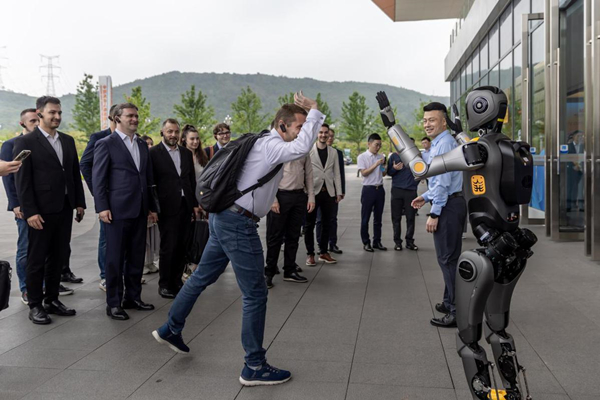
Young political leaders from Central and Eastern European countries visit the Hubei Humanoid Robot Innovation Center in Wuhan, capital of Hubei province, on Sunday, on the sidelines of the 2026 China-CEEC Young Political Leaders Forum. [Photo by Tu Hanming/For chinadaily.com.cn]
Building on such shared aspirations, young CEEC political leaders also offered their perspectives on the role of youth in driving modernization and China-CEEC cooperation, and how this can deliver tangible results to young people on both sides.
Serbian Minister of Culture Nikola Selakovic said that new generations hold a special space in advancing the China-CEEC partnership, spanning a wide range of fields from sustainable development and environmental protection to strengthening science and technology in social governance.
Serbia recognizes that young people are the most important resource and the bearers of future development, he said, emphasizing that his country is not only building programs for young people, but building the future together with them.
Martin Klus, former deputy speaker of the Slovak Parliament, said that young people from different countries, cultures, and political systems often share remarkably similar aspirations.
"They want opportunities, dignity, security, and a chance to shape their own future," he said, adding that his years of experience in youth programs and public service have reinforced his conviction that "investing in young people is not a matter of generosity – it is a matter of responsibility".
"Our countries may differ in many respects, but we share a common interest in stability, prosperity, and development. Most importantly, we share a responsibility to leave future generations a better world than the one we inherited," he said.
Mirjana Vlahovic Andrijasevic, state secretary at Montenegro's Ministry of Health, emphasized that "no society can be truly modern if it does not invest in the knowledge, health, and potential of its young generations".
"Young people are not merely beneficiaries of the future we are building; they are its creators," she said. "Their ideas, energy, innovations, and ability to understand a world that is changing faster than ever before, represent the greatest asset of any nation."
Irena Lukajic Korica, adviser to the Office of the Serb Member of the Presidency of Bosnia and Herzegovina, offered a concrete example of how CEEC-China cooperation has brought tangible benefits.
She said her friend is working on one of the largest Chinese-supported renewable energy projects in Bosnia and Herzegovina – a solar power plant valued at more than 100 million euros ($116 million).
"Through his experience, I have seen how international cooperation can create opportunities, transfer knowledge, and contribute to local development," she said. "For many young people, such projects are tangible examples of partnership and shared progress."
On the sidelines of the forum, the foreign guests visited the Hubei Humanoid Robot Innovation Center, the Wuhan Institute of Industrial Innovation and Development, the Baibuting Residential Community, and Central China Normal University.
As the on-site tours offered them a firsthand look at Chinese modernization, they spoke highly of the country's strides in technological innovation, community governance, and cultural exchange activities.
Liu Kun contributed to this story.