
News and Policies
Guilin's sci-tech innovation pilot zone gains momentum in 2026
Updated: Apr 10, 2026
guangxi.chinadaily.com.cn/guilin
Print
Share - WeChat

Guilin has accelerated the construction of a key strategic project for Guangxi's innovation-driven growth – the sci-tech innovation pilot zone anchored in the city since 2026, following the official release of the zone's construction plan by Guangxi Zhuang autonomous region on Jan 24.
The initiative, outlined in Guangxi's guidelines for building a high-level, innovative region, integrates technological and industrial innovation.
A cross-departmental coordination mechanism is in place, with 51 targeted tasks under five core action plans to drive implementation.
Specialized training programs and flagship initiatives, including "Innovation Talk Series" and "Alumni Homecoming", which focused on engaging alumni to contribute to local development, have cultivated a vibrant citywide atmosphere for technological innovation.
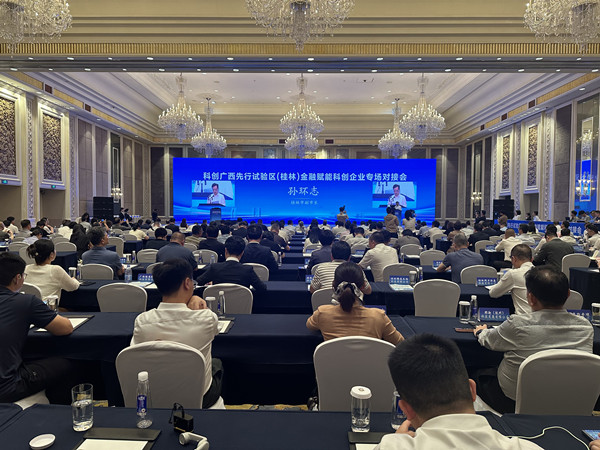
Sun Huanzhi, vice-mayor of Guilin, delivers a speech. [Photo provided to guangxi.chinadaily.com.cn/guilin]
Four innovation hubs in Lingui, Qixing, Yanshan and Huajiang districts of Guilin have been built to provide R&D office space, business incubation, small-batch trial production, professional services and supporting amenities. To date, 82 tech-focused enterprises and R&D teams have established operations here, with a dedicated sci-tech service unit assigned to each hub in line with a tailored management model.
In the first quarter of 2026, Guilin collected 62 incubation projects, 59 new growth curve projects, 36 technological research projects and 33 new-track investment projects. Twenty-five technology demand projects were recommended to the regional department of science and technology.
The "Alumni Homecoming" initiative has attracted seven potential projects, including a high-end electronic technology manufacturing project with a total investment of 100 million yuan ($13.80 million) that has signed a cooperation agreement.
Liang Hong, head of Guilin Municipal Finance Bureau, emphasized that the government will always take supporting technological innovation as a key task, optimize the sci-tech financial service system, and provide all-round support for the development of sci-tech enterprises, helping local tech enterprises enhance their core competitiveness.
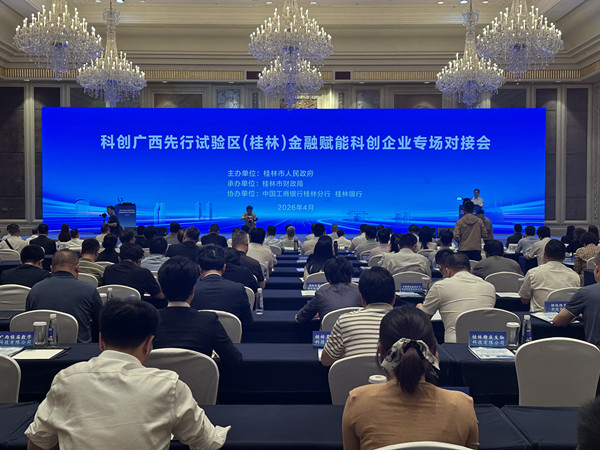
At the event venue . [Photo provided to guangxi.chinadaily.com.cn/guilin]
A full-chain financial support system has been built, with a sci-tech fund matrix of over 2 billion yuan. In the first quarter, financial institutions lent over 6.48 billion yuan to the sci-tech sector, and technology-based enterprises received over 4.41 billion yuan in interest-subsidized loans. Direct financing through the capital market reached 1.15 billion yuan, a year-on-year breakthrough. Venture capital totaling 310 million yuan was invested in local enterprises.
Li Linxuan, founding partner of Theseus, stated that the company is firmly rooted in Guilin and will build a South China R&D headquarters here. As a hard technology enterprise incubated by the Chinese Academy of Sciences system, the company will help build a common technology platform for intelligent perception with its independent core technologies, deepen industry-university cooperation, and help build Guilin into an innovation highland.
Guilin invites the financial and business communities at home and abroad to invest and collaborate, promising the best environment, policies and services to support innovation and development.